
How to Search the Gilmer Court Docket
Start with the citation, summons, or notice. It names the court that owns the case. A Gilmer police citation routed to Gilmer Municipal Court belongs to the city, not to the County Clerk portal. For local contacts and current forms, use the official Gilmer Municipal Court page, which does not present the Tyler UCMS portal as the city docket.
- Read the court name and copy the citation or case number exactly.
- Use the Gilmer city page to choose the current plea, extension, payment-plan, defensive-driving, or deferred-disposition form.
- Contact the Gilmer clerk with the case number and ask for the current setting and status.
- Request the specific docket entry or document needed, and ask whether a fee applies.
- If the notice names a county court, use the County Clerk or District Clerk instead.
Watch the response deadline while you hunt for the record. Asking for a copy does not push back a Gilmer court date.
Gilmer Clerk and Court Route
Danielle Hammonds is the Gilmer court clerk. The office sits at 110 Buffalo Street, Gilmer, Texas 75644. The main court number is 903-843-2751. Counter hours run Monday through Friday from 8:00 a.m. to 4:30 p.m. Other lines exist. The city page also posts 903-843-2552 and 903-843-3508. So call the main court number first, but confirm it rather than treat it as the only possible line.
Gilmer Municipal Court
110 Buffalo Street
Gilmer, Texas 75644
903-843-2751
Monday through Friday
8:00 a.m. to 4:30 p.m.
The clerk is the direct source. Details matter. Give enough facts about the case to separate it from another record with a similar name, whether you need a docket entry, a current form, payment status, or a copy.
The Gilmer Municipal Court
Gilmer Municipal Court hears city ordinance violations and Class C misdemeanors, including traffic citations filed by the proper local authority. Rebecca Skinner is the presiding judge. Lyle Potter is the on-call judge. Check the city page itself if a later setting depends on who is assigned.
This is not the constitutional Upshur County Court. It is not the 115th District Court either. Its record can show the charge, a plea, scheduled events, an order, and the disposition. Being the county seat does not turn a municipal case into a district case.
The city runs on a direct, form-based model, which makes the clerk page essential for current instructions. The docket is different. It is the time-ordered history of what occurred in one case.
Gilmer Plea and Payment Forms
Gilmer posts separate forms for pleas, extensions, payment plans, defensive driving, and deferred disposition. Each route does something different. A plea answers the allegation. An extension seeks more time under the court's process. A payment plan sets how an ordered amount gets paid. Defensive driving and deferred disposition come with their own eligibility and completion terms.
| Gilmer form | What it addresses | Docket check |
|---|---|---|
| Plea | The response to the charge | Confirm the plea was entered |
| Extension | A request for more time | Confirm approval and new date |
| Payment plan | Payment terms after court action | Confirm due dates and balance |
| Defensive driving | A requested compliance option | Confirm eligibility and proof deadline |
| Deferred disposition | Conditions set for a stated period | Confirm order, end date, and result |
Filing a form is just a request. The judge still has to grant it, so look for the resulting Gilmer court entry or get confirmation from the clerk.
Gilmer Court Dates and Settings
A Gilmer court date comes from the citation, a later notice, or a setting the clerk confirms. Office hours tell you when the counter is open. They do not promise a hearing at any point in that span. Use the case number when asking about a setting.
| Date | The day assigned on the citation or later Gilmer order. |
|---|---|
| Time | The stated appearance time, separate from office hours. |
| Place | The court location shown on the current notice. |
| Judge | The judicial officer assigned to the event, if shown. |
| Setting type | An appearance, pretrial, trial, compliance review, or other event. |
A reset moves an event. It does not dismiss the charge, so when two dates appear, ask Danielle Hammonds or the current clerk which setting controls.
Gilmer Standing Orders Need Date Checks
The municipal page links standing orders dated October 1, 2024. A standing order sets procedure for a whole class of cases. An order entered in one Gilmer docket does less. The date shows which version the city had posted. It does not prove that no later order exists.
Open the order from the official page. Note its effective date. Compare it with your case date. Then confirm the court still applies that version, and if a form and an order differ, ask the clerk which instruction is current. Save the completed form and proof of delivery.
A dated standing order supplies procedure. The individual court docket remains the source for events in one case.
Gilmer Traffic Tickets
A traffic ticket filed in Gilmer municipal court creates a city case, not a Tyler UCMS County Clerk case by default. Read the court line on the ticket first. Keep the citation number, the alleged violation, the issue date, the appearance date, and the name exactly as written. Those details let the clerk pull the right docket.
Paying is one action. Pleading not guilty is another. Defensive driving and deferred disposition are different again. The Gilmer forms page lists each route, though the court decides what is available in a specific case. Verify the amount and deadline before acting. A payment may carry a plea consequence, so never treat the payment link as a neutral record-search button.
County and justice-court tickets follow other channels. The Upshur County traffic court records page maps them. It does not replace the city clerk.
Gilmer Seat and Court Scale
Gilmer, the Upshur County seat, counted 4,843 residents in the 2020 Census. The Census P1 city count gives the figure. Because the city holds the county seat, several court offices operate in Gilmer. That fact trips up docket searches. People assume one counter holds every file. The assumption sends them to the wrong office.
Before picking a building or portal, ask which court created the file. City Hall holds the Gilmer municipal record. The County Clerk and the District Clerk each keep separate county-level files.
Where Gilmer Cases End Up
Each tier of the Upshur County system has its own Gilmer docket. Gilmer Municipal Court handles the municipal tier. A Justice of the Peace court takes Class C cases, small claims, and evictions. It also handles its other authorized matters. Probate and county-level jurisdiction run through the constitutional County Court and the County Clerk. The 115th District Court handles felony, major civil, family, juvenile, and tax cases. It works through the District Clerk.
Docket flow: Gilmer Municipal Court › Upshur County Courts › 115th District Court of Texas
Think of this as a search map. It does not mean Gilmer cases move through every court listed. Match the charge or claim to the court that actually filed it. Appeals follow their own route. A trial-court docket stays with its trial clerk no matter what happens later.
Gilmer City and District Dockets
A Gilmer traffic citation and a 115th District Court cause share only a city name. They remain wholly separate files. The city docket may show a traffic charge, a plea, a setting, a judgment, and a fine. The district docket holds a felony charge or a major civil, family, juvenile, or tax case. The Upshur District Clerk keeps that district docket. Gilmer Municipal Court does not.
| Point | Gilmer Municipal Court | 115th District Court |
|---|---|---|
| Typical matters | City ordinance and Class C cases | Felony and general-jurisdiction matters |
| Custodian | Gilmer municipal clerk | Upshur District Clerk |
| First route | Gilmer court page and direct contact | District Clerk page, phone, or counter |
When a notice names a county court, the county case-search routes will point you right. A city citation belongs with Gilmer's own channel instead.
Gilmer Docket Terms in Plain Words
Short labels hide things. A request, a scheduled hearing, and a final result can all look alike on a Gilmer docket line. Read the full sequence of entries before deciding what happened in a case.
- Plea
- The formal answer to the municipal charge.
- Extension
- More time granted by the court; a request alone is not approval.
- Setting
- A date and time placed on the Gilmer docket.
- Deferred disposition
- A court-ordered period with terms whose completion can affect the final result.
- Disposition
- The recorded way the case ended.
A form only starts a request; a signed or entered court action shows what the judge did with it.
Gilmer Historic and Modern Counters
Gilmer's county-seat status and its historic courthouse do not merge the modern municipal counter with the county's record offices. The city court works out of City Hall at 110 Buffalo Street. The county trial and clerk offices keep their own custody lines.
The split matters for old records as much as current ones. A county clerk may index a decades-old county cause. Gilmer, meanwhile, holds a current city citation. Statewide re:SearchTX adds a layer for participating state cases. It won't guarantee a Gilmer municipal ticket appears there, though.
Public Access to Gilmer Court Records
Request a public docket entry or document from the Gilmer clerk by citation number, name, and approximate date. State access rules still bar sealed information, juvenile material, and sensitive identifiers. A portal may return only an index line. An official copy comes from the clerk itself.
Key rules:
Texas judicial open-records policy describes Rule 12 access to qualifying judicial records.
Texas Government Code Chapter 552 explains the wider public-information framework and judiciary distinction.
Texas Rule 21c protects sensitive data in filed court papers.
Before mailing or submitting anything, use the city's official municipal page to confirm the current contact and form. It beats guessing at an outdated number.
Gilmer Court Page Snapshot
The official Gilmer court page lists the city's forms and contact details. That page, not a general county portal, is the main route for Gilmer court business. The link above goes straight to it.
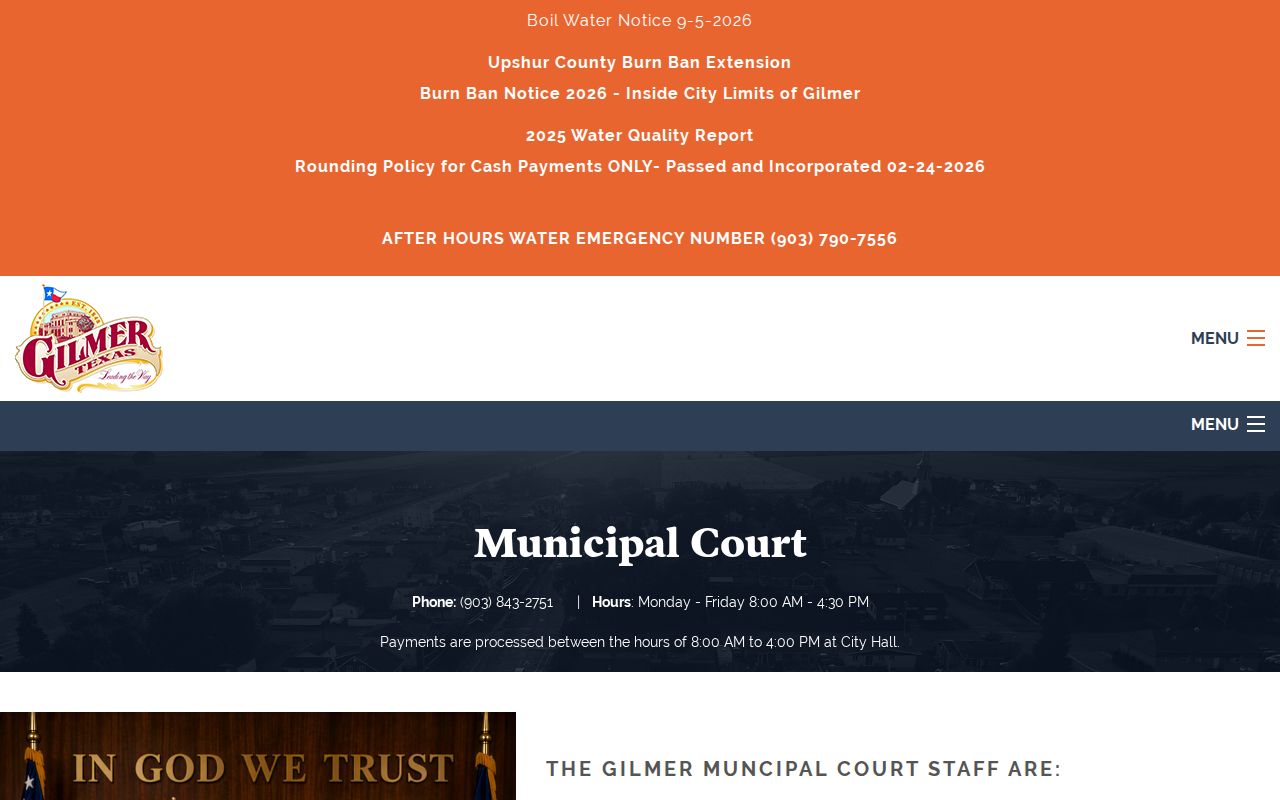
Details on a city web page shift over time. Open the linked city source for current form names, court staff, and phone details.
Gilmer Copy Request Checklist
Hand the clerk the citation number. Give the exact name and the approximate date. State the item you want. A docket sheet traces the events. The plea, order, or judgment holds the text behind an entry. Tell the clerk whether you need a plain or certified copy.
No fixed response time or single copy charge applies to every Gilmer document. Ask for the current fee and the delivery route. Keep proof of any written request, and follow up on the main court line. One caution: a records request never extends an appearance deadline.
Gilmer Form Follow-Through
Filing a Gilmer form starts a request. It does not finish the docket task. After delivering a plea, extension, payment plan, defensive-driving request, or deferred application, ask the Gilmer clerk whether the court accepted it. Write down the Gilmer case number and check date.
For an extension, confirm the new Gilmer deadline. For a plan, confirm each Gilmer due date. Defensive driving needs a confirmed proof deadline, and a deferred disposition calls for a careful read of the Gilmer order. A receipt proves you paid. The docket shows how the Gilmer court applied the payment.
Keep the form with the Gilmer citation and every Gilmer notice. That bundle lets the clerk fix a date or status mismatch fast.